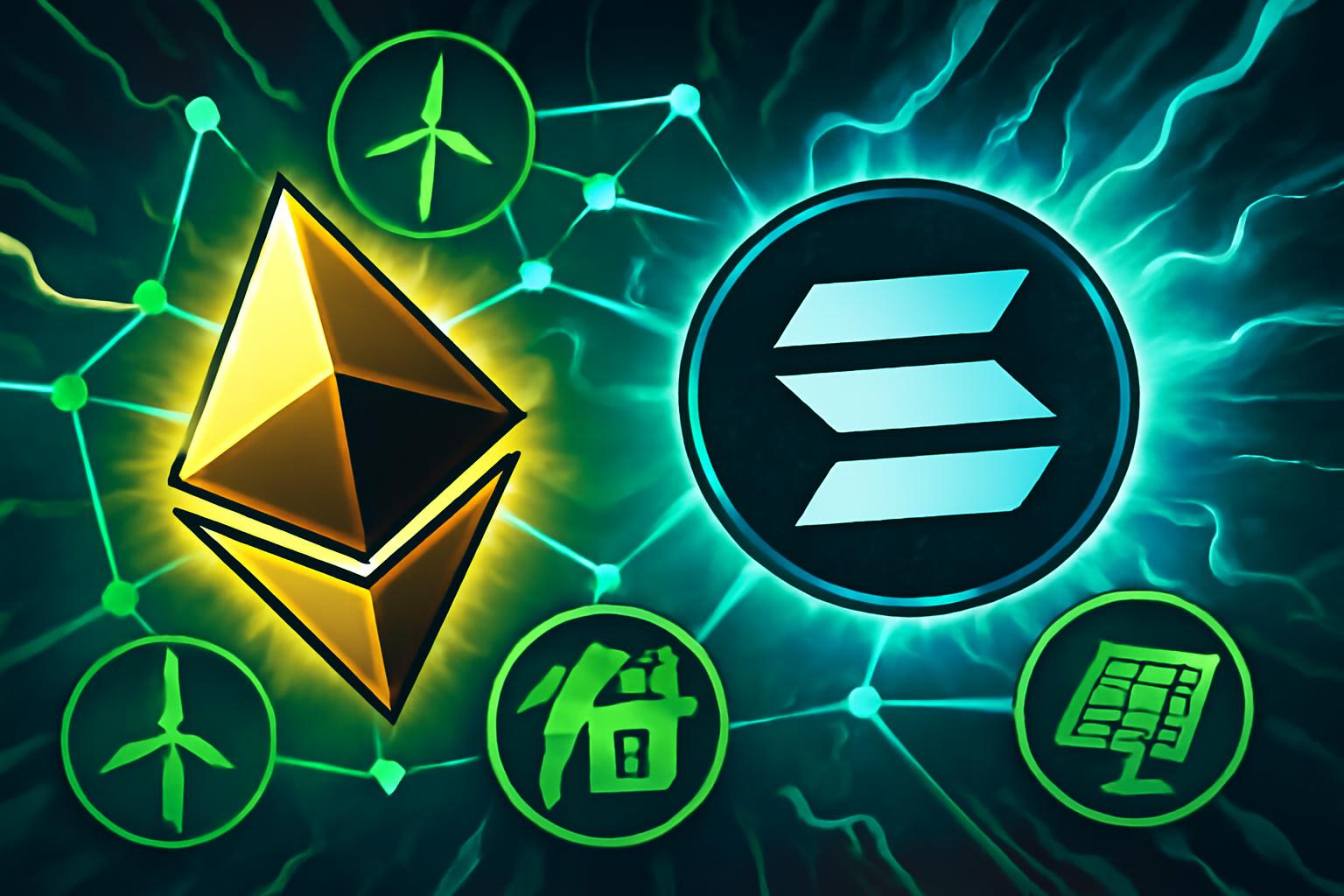

The blockchain in the energy market shows impressive growth — from $3.1 billion in 2024, it’s expected to hit over $90 billion by 2034. Behind these figures sit real problems: how do you track where exactly your electricity came from? How do you make sure that a renewable energy certificate is legit? The Blockchain technology in the energy market offers answers to these questions.
Imagine a massive notebook that thousands of people store simultaneously. When someone adds a new entry, all copies update automatically. Faking something would be impossible — you’d need to change records in all of them at once. That’s exactly how blockchain works.
For the energy sector, this technology opens up new possibilities: Peer-to-peer energy trading — solar panel owners can sell excess electricity directly to neighbors, without an energy company as a middleman. The system automatically calculates who produced and consumed how much. Energy origin tracking — every kilowatt gets its own digital passport. When buying “green” electricity, you see it’s really from a wind farm in Colorado, not from a coal plant. Automation through smart contracts — deals execute themselves. For example, when your electric car charges, blockchain automatically calculates the cost and processes payment without your involvement. Distributed energy resource management — thousands of solar panels, wind turbines, batteries coordinate as a single system. Blockchain helps balance supply and demand in real time. Renewable energy certification — every “green” certificate becomes a token on the blockchain. This makes double-selling the same portion of clean energy impossible. Carbon credit transparency — companies reducing emissions get tokenized credits. The entire market becomes honest because you can see each credit’s history from beginning to end. The Blockchain technology in the energy market solves the main problem of decentralized energy coordination. When millions of devices produce and consume energy, traditional systems can’t handle the accounting. Blockchain does this naturally.
DXC Technology is a global tech company specializing in the digital transformation of the energy sector. Their experience with operational technologies is valuable for utilities transitioning to distributed generation systems. DXC develops distributed energy resource management systems (DERMS) that help energy companies efficiently manage solar panels, wind turbines, and batteries. They actively work on blockchain integration to ensure transparency in energy trading and tracking renewable electricity attributes.
Power Ledger is an Australian company, founded in 2016, that became a pioneer in peer-to-peer energy trading. Their platform runs on Solana blockchain, which processes tens of thousands of transactions per second with minimal energy costs. Power Ledger operates in ten countries — from India to Austria. In Northern India, their pilot project showed impressive results: electricity prices for consumers dropped 43% compared to retail tariffs. After this, the Uttar Pradesh state government made peer-to-peer trading mandatory for all utilities. The company offers several products: uGrid for commercial buildings, xGrid for the residential sector, and TraceX for renewable energy certificate trading. In Thailand at Chiang Mai University, 142 buildings trade energy among themselves, achieving 30% autonomy from renewable sources.
Energy Web Foundation is a global nonprofit that developed Energy Web Chain — the first blockchain created specifically for the energy sector’s needs. Unlike universal platforms, EW Chain accounts for regulatory requirements and technical specifics of utilities. Energy Web is supported by over 100 affiliated companies, including Shell, Siemens, and Iberdrola. Their technology is used for various applications: from decentralized electric vehicle charging to grid flexibility management. The foundation also developed SAFc Registry — a registry for sustainable aviation fuel certificates running on blockchain. This helps airlines track and report emission reductions with complete transparency.
IBM is a tech giant that invested $6.9 billion in research and development in 2024, with a significant portion directed at blockchain in the energy market. IBM uses its Hyperledger Fabric framework to tokenize renewable energy certificates. Their enerT solution creates digital tokens storing information about energy generation and CO₂ emissions. This makes certificate trading more efficient and cheaper since the entire process is automated and transparent. IBM actively collaborates with utilities worldwide, integrating blockchain into energy trading systems. Their experience with corporate clients allows quick scaling of solutions.
Accenture implements blockchain solutions in diverse energy spheres. In Italy, Accenture, together with the state institute GSE, created two blockchain systems. The first tracks biomethane from farm to pump, ensuring complete supply chain transparency. The second manages a network of charging stations for electric vehicles powered exclusively by “green” energy. A mobile app lets users see the electricity origin and earn rewards for ecological behavior. Accenture also developed Avelia together with Shell and American Express GBT — a blockchain platform for sustainable aviation fuel trading. The system uses smart contracts to automatically distribute environmental attributes between airlines and corporate clients.
SAP, the German software giant, invests about 15% of its revenue in research, including blockchain technology in the energy market. Their GreenToken project creates digital twins of raw materials, allowing companies to track the environmental footprint of materials. SAP integrates blockchain into its cloud solutions for the energy sector, improving data accuracy and security. Their systems automate energy trading, billing, and settlements through smart contracts.
LO3 Energy is an American company known for its Brooklyn Microgrid — one of the first peer-to-peer energy markets in the US. Neighborhood residents can buy solar energy directly from neighbors through a blockchain platform. LO3 develops innovations allowing local communities to generate, store, and trade energy at the microgrid level. Their technology makes energy systems more resilient to centralized grid failures. In 2024, the company launched a pilot microgrid project using blockchain for energy distribution. This demonstrates how local communities can become energy independent.
Siemens, the German industrial giant, integrates blockchain into its smart grid solutions, enabling peer-to-peer energy trading. Siemens works on protecting critical infrastructure from cyberattacks using decentralized security mechanisms. The company uses blockchain to optimize grid management through smart contracts. This increases energy infrastructure reliability through real-time monitoring.
ACCIONA ENERGY, this Spanish company, became a pioneer in using blockchain for renewable energy origin certification. Their YEK-G system ensures transparency and reliability, letting consumers verify that electricity really comes from renewable sources. Acciona uses blockchain to track production and energy storage processes. The technology guarantees source code protection in proprietary applications, ensuring data integrity.
ORACLE, the tech giant, earned $52.9 billion in fiscal 2024 and actively develops blockchain in the energy sector. Oracle embeds blockchain into its software solutions for energy, especially in solar credit tokenization. In April 2024, Enact Systems integrated Oracle Blockchain technology into its award-winning solar energy platform. This solution simplifies solar project management and ensures financial transaction transparency.
The Blockchain technology in the energy market faces real challenges. Regulatory uncertainty remains the biggest obstacle — legislation simply can’t keep up with technology. Many countries lack clear rules for peer-to-peer energy trading, which slows implementation. Technical complexity is no joke either. The blockchain “trilemma” — choosing between scalability, security, and decentralization — forces developers to compromise. Energy platforms must process thousands of transactions per second while remaining secure and decentralized.
Implementation with legacy IT systems presents another major headache. Utilities spent decades building their IT infrastructure. Replacing everything with blockchain is impossible — we need to find ways to integrate. This requires time, money, and technical expertise. Still, the prospects are impressive. By 2034, the blockchain technology in the energy market could reach $548 billion, according to some forecasts. This isn’t just market growth — it’s a fundamental change in how energy works. Virtual power plants uniting thousands of small sources into a single system will become the norm. Microgrids will let neighborhoods and cities achieve energy independence. Cross-border energy trading will become simpler and more efficient. The changing consumer role. People will stop being passive electricity receivers. They’ll become active energy market participants who produce, store, and sell energy. Blockchain makes this possible by ensuring transparency and automation.
CONCLUSIONS The Blockchain technology in the energy market isn’t just a tech trend. It’s the answer to a real problem: how to manage an energy system where millions of devices simultaneously produce and consume electricity. The ten companies we examined are already building this new energy system today. The Blockchain in the energy sector changes the fundamental rules. Energy becomes digital, decentralized, and democratic. Utilities stop being monopolists — they become platforms for exchange. Consumers gain control over their energy and the ability to earn from their surpluses. The next ten years will show how deep these changes run. One thing’s clear: energy will never be what it was before.







Leave a Reply