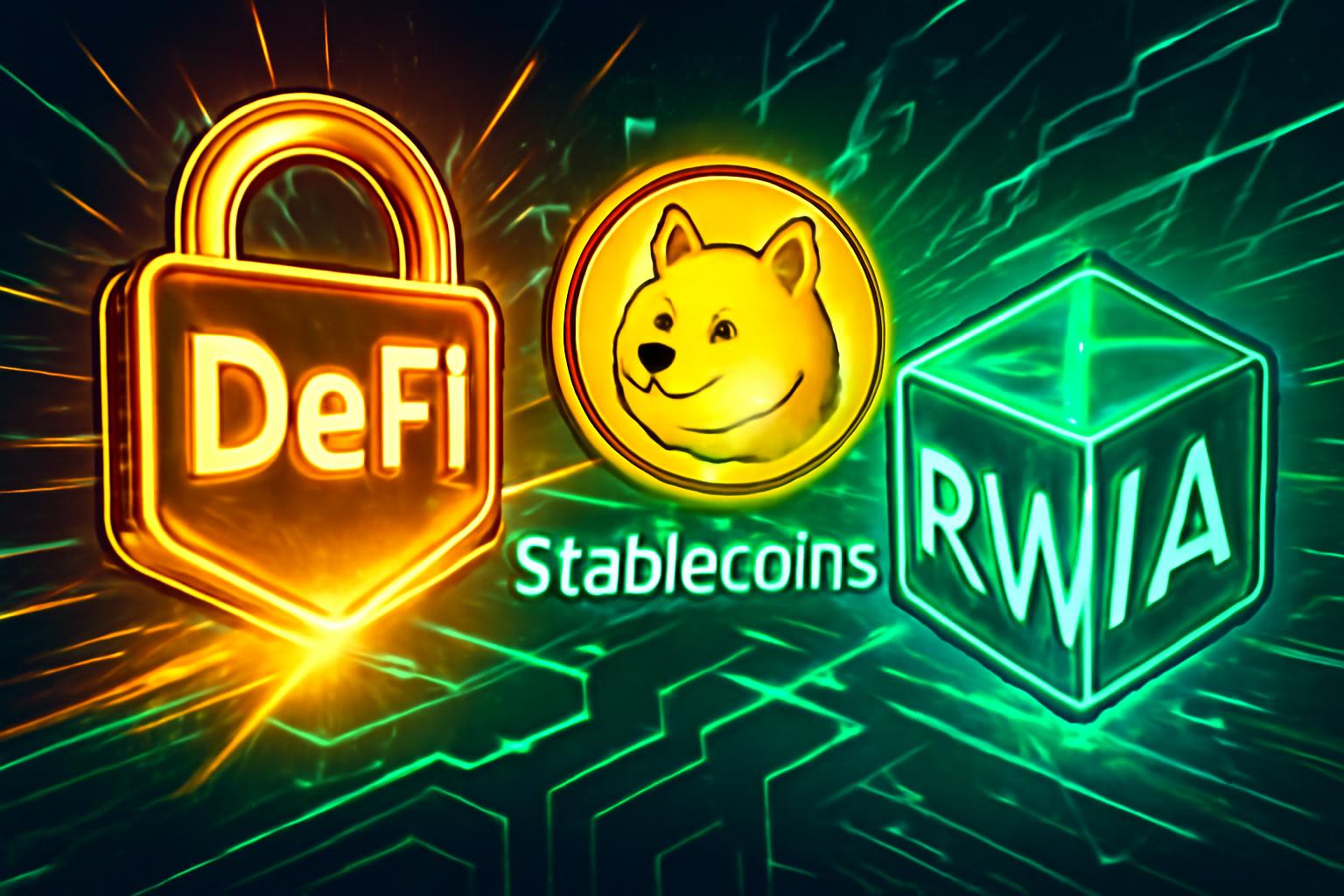

If you were to close your eyes and summon the ghost of 2020, you would likely smell the digital equivalent of ozone and gunpowder. It was the era of the DeFi Summer, a period that felt less like a financial revolution and more like a high-stakes arcade game played in a fever dream. We were all alchemists then, trying to turn food tokens Yam, Sushi, Pickle, into gold. Fast forward to 2025, and the landscape has been terraformed.
The story of DeFi over these last five years isn’t just a story of going mainstream; it’s a story of a fundamental, molecular change in what decentralized finance actually is. The biggest shift is the integration of real-world assets and stablecoins into what was once a purely speculative environment, Lin observes. DeFi has expanded from high-yield experiments to a diverse asset ecosystem that now includes treasury products, stablecoins, and institutional-grade instruments, creating a more balanced and functional financial landscape. This is the maturation of the DeFi Summer into a DeFi Autumn, a season of harvest and stability.
In 2020, we were chasing ghosts. In 2025, we are trading the bedrock of the global economy. The high yields of the past were often just a tax on latecomers; today’s yields are generated by the actual productivity of government bonds and real estate. In the old days, if we can call five years ago old we were obsessed with TVL.
We watched the billions pile up like a scoreboard in a stadium. But we eventually learned that TVL was a deceptive god. We no longer ask “How much is locked?” but “What is actually being used?” There is no universal metric because it depends on what you are evaluating, Lin explains. But one emerging important metric is stablecoin TVL. It reflects real demand and cannot be inflated by native token mechanics, which makes it a cleaner measure of genuine usage and capital trust. When you look at a stablecoin, you aren’t looking at a “moonshot” or a meme. In 2025, a protocol’s health is measured by its ability to attract stable, non-volatile capital. This shift in metrics represents a shift in the very psychology of the market: from gambling to banking.
For years, the cypherpunks and the degens laughed at the idea of big banks entering DeFi. “They’ll never understand it,” we said. “The regulations will stop them,” we thought. But the banks didn’t come to DeFi to join a revolution; they came because the old plumbing of the financial world was leaking, and DeFi offered a new set of pipes that were faster, cheaper, and impossible to clog. Large institutions, such as banks, have already begun deploying in DeFi. Still, they are more likely to enter through compliant instruments, for example, on-chain stocks approved by the SEC and cleared through the DTCC and implement stricter KYC processes on-chain. This is not the DeFi of 2020, where you could trade millions with nothing but a wallet address. This is a regulated, “permissioned” DeFi.
Ardern sees this as the birth of a new kind of global market. Unlike the previous “Wild West” style of DeFi, with the support of the latest blockchain analytics and KYC technologies, they will create a DeFi space more like the offshore interbank market and offshore FX market. A series of mature solutions based on these two markets will be blockchained, becoming more transparent and faster. This is a crucial insight.
The Interbank market, the hidden world where banks lend to each other, is the engine of the global economy. By moving this engine onto the blockchain, banks are gaining the transparency they never had before. In the 2008 crisis, banks stopped lending because they didn’t know who was solvent. In the DeFi-enabled interbank market of 2025, solvency is verifiable on-chain in milliseconds. The bridge that finally allowed the “suits” to cross into the world of the “hoodies” was the tokenization of Real-World Assets (RWA). In 2020, we talked about putting the world on-chain. In 2025, we are actually doing it. Whether it’s a fractionalized apartment in Berlin or a U.S. Treasury bill, the blockchain has become the ultimate ledger of record. RWA tokenization is a major catalyst, but it is not the sole reason banks are entering the space. Banks ultimately follow capital flows, so users should understand that their dollars act as a vote. As liquidity grows on-chain, traditional institutions are compelled to redesign their systems to participate, which only reinforces how real DeFi’s growth has become. Every time a retail user swaps a traditional savings account for a tokenized yield-bearing stablecoin, a bank loses a deposit. To survive, the banks have had to follow those dollars onto the chain. It is a rare example of the “little guy” forcing the hand of the giants through the sheer gravity of capital.
Is it safe yet? In 2020, the answer was a resounding “No.” In 2025, the answer is “Yes, but…” DeFi is safer and more intuitive than it has ever been, but each user should always approach it with clear goals and a plan. With better UX, clearer guardrails, and AI reducing complexity for everyday decision-making, the path to mainstream adoption is gaining momentum. The introduction of AI as a “financial co-pilot” in 2025 has changed the game. Instead of reading through pages of smart contract audits, users now have AI agents that can scan a protocol for vulnerabilities in real-time or explain the risks of a specific liquidity pool in plain English. The complexity hasn’t disappeared—it’s just been buried under a layer of intelligent design.
The journey from 2020 to 2025 is the story of a market growing up. We have moved from the “DeFi Summer” of speculation to the “DeFi Standard” of global finance. We see the vision of Griffin Ardern, where the “offshore interbank market” is being rebuilt on a transparent ledger. We see the pragmatism of Vivien Lin, who recognizes that stablecoins and RWAs have anchored the industry to reality. And we see the honest appraisal of Fernando Lillo Aranda, who reminds us that for all our progress, the human need for simplicity and trust still drives the majority of users toward centralized hubs. In 2020, DeFi was an experiment that might have failed. In 2025, DeFi is an infrastructure that must work. The “Wild West” has been tamed, not by the sheriff, but by the engineers, the bankers, and the millions of users who decided that their dollars were better off on a blockchain than in a vault. The story isn’t over. The tension between privacy and regulation, between decentralization and ease-of-use, will define the next five years. But as we look back at the chaos of 2020 from the vantage point of 2025, one thing is clear: we aren’t playing a game anymore. We are building the future of money, one block at a time.









Leave a Reply