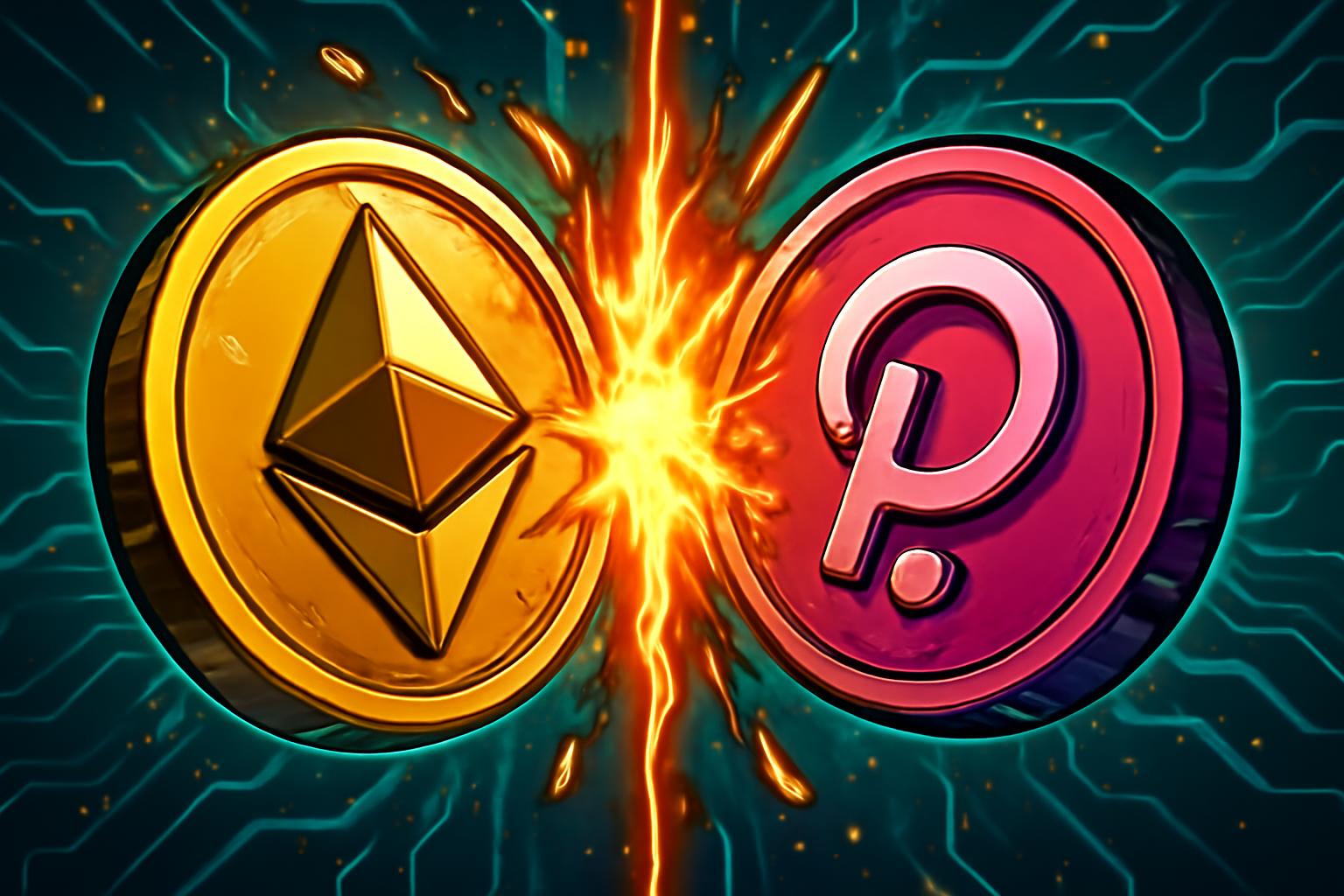

Ethereum (ETH) and Polkadot (DOT) generally attract different types of cryptocurrency investors. Ether, the native token of the Ethereum blockchain, is the world’s second-most-valuable cryptocurrency after Bitcoin. It’s often considered a “blue chip” token, more stable than smaller altcoins or meme coins. A $10,000 investment in its earliest trade in 2015 would be worth $10.5 million today.
Polkadot is a smaller altcoin created by Ethereum’s co-founder, Gavin Wood. A $10,000 investment in its first trade in 2020 would have shrunk to about $6,900. Let’s see why Ethereum flourished as Polkadot fizzled out — and if either coin can deliver more millionaire-making gains. Ethereum was originally a proof-of-work (PoW) blockchain like Bitcoin, but it transitioned to the energy-efficient proof-of-stake (PoS) consensus mechanism in 2022.
After that transition, known as “The Merge”, Ether could no longer be actively mined like Bitcoin. Instead, its token could be staked for interest-like rewards. It also gained support for smart contracts, which developers used to create decentralized applications (dApps), non-fungible tokens (NFTs), and other tokenized assets. Today, it’s the largest platform for developing dApps, and Ether’s value is usually reflected in the growth of its developer ecosystem.
Polkadot’s blockchain is built on the PoS consensus mechanism, so it natively supports smart contracts and dApp development. Its core Relay Chain handles all security, validation, and cross-chain communication, while all its apps run across its parachains, which have their own logic, governance, and tokenomics rules. That structure makes Polkadot’s parachains more flexible than Ethereum’s Layer-1 (L1) blockchain, which requires all of its smart contracts to follow the same rules. They also tend to process transactions at faster speeds than Ethereum’s L1 blockchain.
However, Ethereum allows Layer-2 (L2) blockchains, which can be customized for a wide range of applications, to run on top of its L1 blockchain. By bundling its L1 transactions and processing them on its L2 blockchain, Ethereum can deliver comparable speeds to Polkadot’s parachains and other nimbler PoS blockchains like Solana. Polkadot’s app-specific parachains, predictable fees, on-chain governance, and compliance-friendly architecture could also make it better suited than Ethereum for certain regulated finance, supply chain, and government clients. Nevertheless, Ethereum’s upgrade ideas could be more upside for its ecosystem.
Polkadot could still struggle to stand out in the crowded market of smaller PoS blockchains. Its price might eventually stabilize, but I don’t expect it to generate millionaire-making gains over the next decade. Ethereum, on the other hand, still has significant upside if it becomes the default ecosystem for developing dApps. While it might not replicate its massive gains from the past decade, it could still generate millionaire-making gains over the next few decades.







Leave a Reply