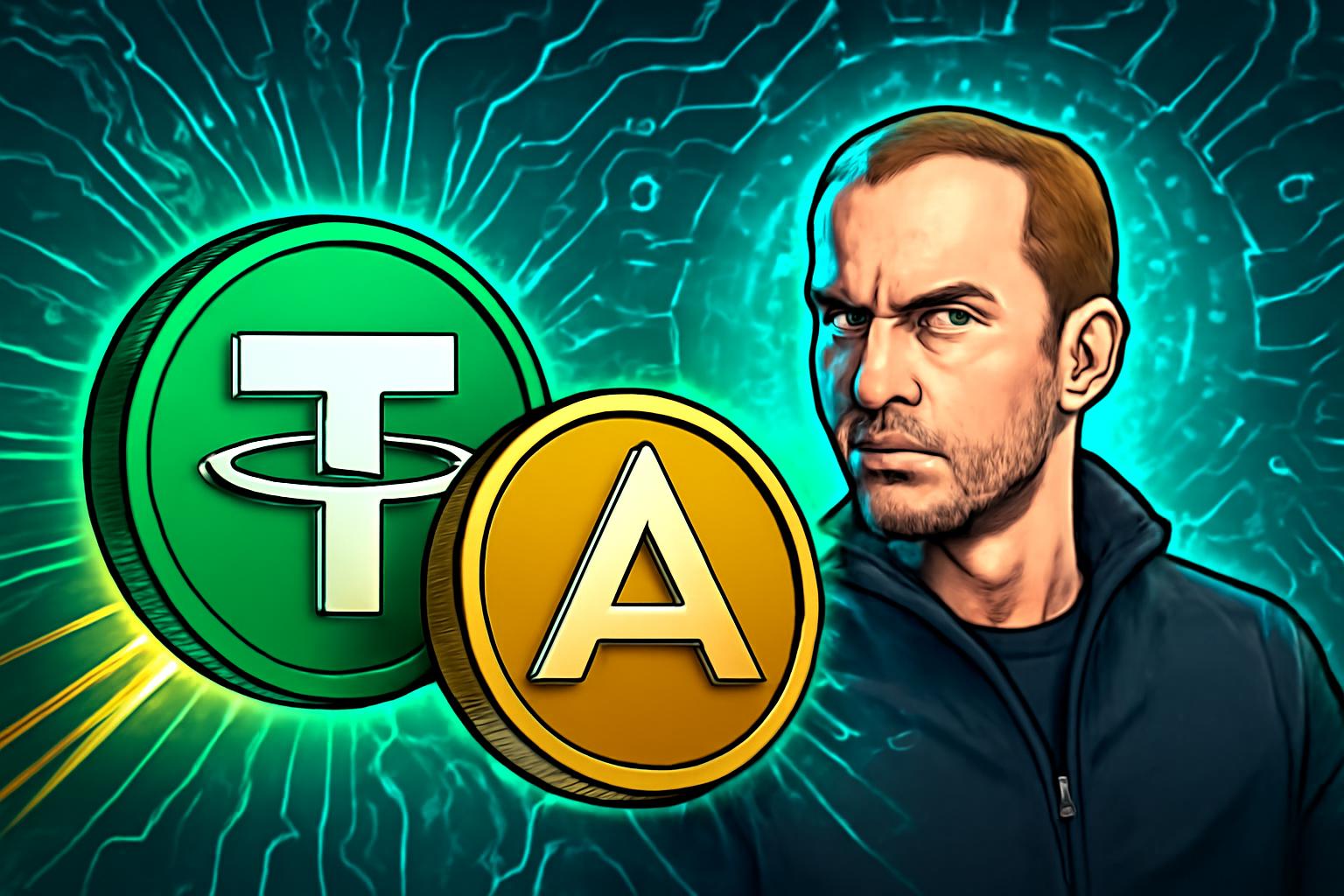

This week, Tether launched USAT, a U.S.-regulated stablecoin issued through Anchorage Digital Bank — its first product designed to comply with new federal rules and compete directly with Circle’s USDC. Fidelity Investments also just launched a competing stablecoin on Wednesday, joining JPMorgan Chase and PayPal in a broadening race. The timing isn’t arbitrary. For years, Ardoino avoided the United States, watching from offshore as regulators circled and prosecutors investigated.
His company was portrayed as opaque, possibly fraudulent, and, according to a piece by The Economist last summer, a “money launderer’s dream.” But when Ardoino and I chatted by video call this week, it was clear those days are over. Tether is meeting with White House officials, collaborating with the FBI and Secret Service, and betting USAT can break Circle’s grip on the U.S. market. (USAT is separate from Tether’s flagship USDT, which has $187 billion in circulation globally but doesn’t meet new U.S. regulatory requirements.)
Speaking from Lugano, Switzerland, the 41-year-old – who joined the company just two months after its 2014 launch – spent over an hour describing Tether’s transformation from a crypto play to mainstream acceptance. Tether’s USDT — essentially a digital dollar that uses blockchain technology to move across borders without being tied to any single institution — has a market capitalization of $187 billion, larger than of its stablecoin competitors combined. It also has some 536 million users, growing at 30 million per quarter. “It’s growing at a pace more like Facebook rather than any other fintech application,” Ardoino tells me.
The stablecoin race is only escalating, with Fidelity Investments becoming the latest financial giant to launch its own dollar-pegged token, joining JPMorgan Chase and PayPal. “In Argentina, the peso lost 94.5% of its value against the U.S. dollar in the last five years,” Ardoino says. “In Haiti, the average salary is $1.34 per day. These people were never part of the financial system.” “What Tether created is the biggest financial inclusion success story in the history of humanity,” he continues, telling me that the company now works with almost 300 law enforcement agencies across more than 60 countries, and that the transparency of blockchain makes it easier to monitor for illicit activity than traditional banking.
Ardoino knows he has a lot of work to do to convert more people into believers. It didn’t help when, last summer, The Economist detailed how Russian money launderer Ekaterina Zhdanova allegedly used Tether to connect British drug gangs, Moscow hackers, sanctioned oligarchs, and Russian intelligence operatives. When I bring up that reporting, Ardoino brushes it off, calling the amounts highlighted in the piece “truly a drop in the ocean.” The “infinite, vast majority of the usage of USDT is by good people,” he says, adding that “iPhones are sometimes used by bad people, Toyotas are used by bad people.”
“If there are cash pallets of hundreds of billions of dollars roaming around the world, U.S. law enforcement can hardly do anything about it,” he says. “But with USDT, we demonstrated that working with the DOJ, FBI, Secret Service and hundreds of other law enforcement agencies, we could quickly freeze the funds.” In fact, Ardoino says Tether has frozen $3.5 billion in tokens, the vast majority of which belonged to “people who have been scammed or hacked.” In 2023, he says, for example, Tether proactively identified $225 million in a “pig-butchering scam” in the “blink of an eye” after traditional financial systems failed to catch it. “We have onboarded the FBI and the Secret Service. We follow OFAC—the office that enforces U.S. sanctions,” he tells me.
Just three months ago, the S&P Global Ratings called USDT’s stability weak. “If that is the same S&P that completely missed the subprimes, I’m proud they’re considering us weak.” He then points to spring 2022, when another major stablecoin called TerraLuna abruptly collapsed, wiping out $40 billion in value virtually overnight. “We redeemed $7 billion in 48 hours – 10% of our reserves. In 20 days, $20 billion – 25% of our reserves. There is no bank in the world that can survive that level of redemptions. We did it with flying colors.”
Ardoino also hints at a rival that didn’t fare as well during a separate bank run, though he stops short of naming it. The implication is clear — he means Circle. When Silicon Valley Bank collapsed in 2023, Circle’s USDC briefly lost its peg after revealing $3 billion in exposure. When I ask Ardoino directly about Circle — often portrayed as the cleaner alternative — his PR team quickly interjects. He manages only: “Sometimes you are painted in a different light if you don’t bend the knee to Wall Street.”
Ardoino emphasizes that Tether now has $30 billion in excess reserves beyond what’s needed to redeem all outstanding tokens. What’s more, those reserves are held at Cantor Fitzgerald — the Wall Street firm that Lutnick led for over three decades before becoming Commerce Secretary. Lutnick has publicly vouched for Tether’s legitimacy; meanwhile the firm earns fees from managing Tether’s massive Treasury holdings, creating a financial interest that now exists alongside Lutnick’s role shaping U.S. commerce policy. Tether is now safer than traditional banks, is Ardoino’s point.
“The banking system is doing fractional reserve at the length of 90%,” Ardoino says. “So if you deposit $1 million in a bank account, $100,000 is there, and $900,000 is lent out.” By contrast, he argued, “even if Bitcoin would go to zero, Tether would have more money than all the USDT tokens issued.” All those reserves generate enormous profits. According to Fortune, Tether reported more than $15 billion in profit for 2025 derived largely from interest on reserves it doesn’t share with USDT holders.
When I ask whether Tether would reconsider sharing yields, Ardoino says that while interest makes sense for Americans who’ve come to expect it, it’s not top of mind for Tether’s core users, who are primarily trying to preserve value. “The Turkish Lira lost 81% of its value against the U.S. dollar in the last five years. The Argentina peso lost 94.5%,” he says. “So USDT will empower the biggest decentralized AI platform in the world.” For someone whose currency loses 3% daily, a 4% annual interest rate is meaningless.
“While for the rest of the world, U.S. dollar stablecoins are the savings account, you cannot think about stablecoins for U.S. people as the savings account, but more like a checking account.” Ardoino’s ambitions extend far beyond USDT. Tether Gold, a token backed by physical gold that launched in 2020, now has $2.6 billion in circulation, meaning customers hold tokens representing that much gold. According to Ardoino’s Bloomberg interview, the company holds around 140 tons of gold worth roughly $24 billion, making it one of the largest private gold holders in the world. When I ask why Tether launched products like Tether Gold, he frames it as offering alternatives in an uncertain world.
“Gold has been the first big, almost ubiquitous form of currency in humanity,” he says. “For the first time, with blockchain technology, we could actually make gold again a currency used not only as a store of value, but also a way to exchange value.” When the gold product launched, “we were almost called crazy,” he recalls. Since then, Tether has been buying a whopping one to two tons per week, positioning itself as what Ardoino calls “one of the biggest gold central banks in the world.”
But it’s the company’s push into AI that hints at Ardoino’s even bigger ambitions. Roughly nine months ago, Tether rolled out Qvac, Tether’s decentralized AI platform. The name comes from Isaac Asimov’s short story “The Last Question,” which Ardoino sees as the “most magnificent sci-fi piece of literature ever written.” His pitch for Qvac echoes his pitch for USDT, which is to serve the underserved. “USDT never meant to go after people that had an account in JPMorgan,” he explains.
“We went to all the people left behind by the traditional financial system.” Similarly, centralized AI platforms will miss billions of people who can’t afford subscriptions, he says. “If they don’t have enough money for paying $150 per year for a bank account, they don’t have enough money to be onboarded on powerful AI platforms,” Ardoino said. Instead, Qvac will run locally on smartphones. Within three to five years, he believes today’s most powerful smartphones will be commonplace in Africa and South America, enabling 70-80% of AI use cases. “So USDT will empower the biggest decentralized AI platform in the world.”
It’s quite a vision, yet even Qvac is just another prong of a bigger strategy. According to Fortune, Tether has committed more than $1 billion to German AI robotics firm Neura, $775 million to social media platform Rumble, and hundreds of millions more to satellites, data centers, and agriculture. The magazine described Tether’s transformation into something resembling a sovereign wealth fund. When I note that from the outside, these investments — including a stake in the Juventus soccer club — seem disconnected, Ardoino insists they are not. “The motto of Tether is to be the stable company,” he says.
“The reason why we invest in land, cattle, agriculture, modern tech, in gold – the common denominator is ensuring that Tether can remain a cornerstone of the world that is our user.” He describes it as an interlocking system where agriculture can be digitalized, gold markets revolutionized, telecommunications made peer-to-peer. “Our story is about building a company that can stand the test of time,” he says. “It’s becoming a social impact company that is changing the lives of hundreds of millions of people and providing them something they never had before – stability.” “I hope that financial inclusion and bringing 536 million people on board onto the dollar is something that both Republicans and Democrats care about,” he says. Ardoino is joining us at TechCrunch Disrupt, happening in San Francisco October 13-15.



Leave a Reply