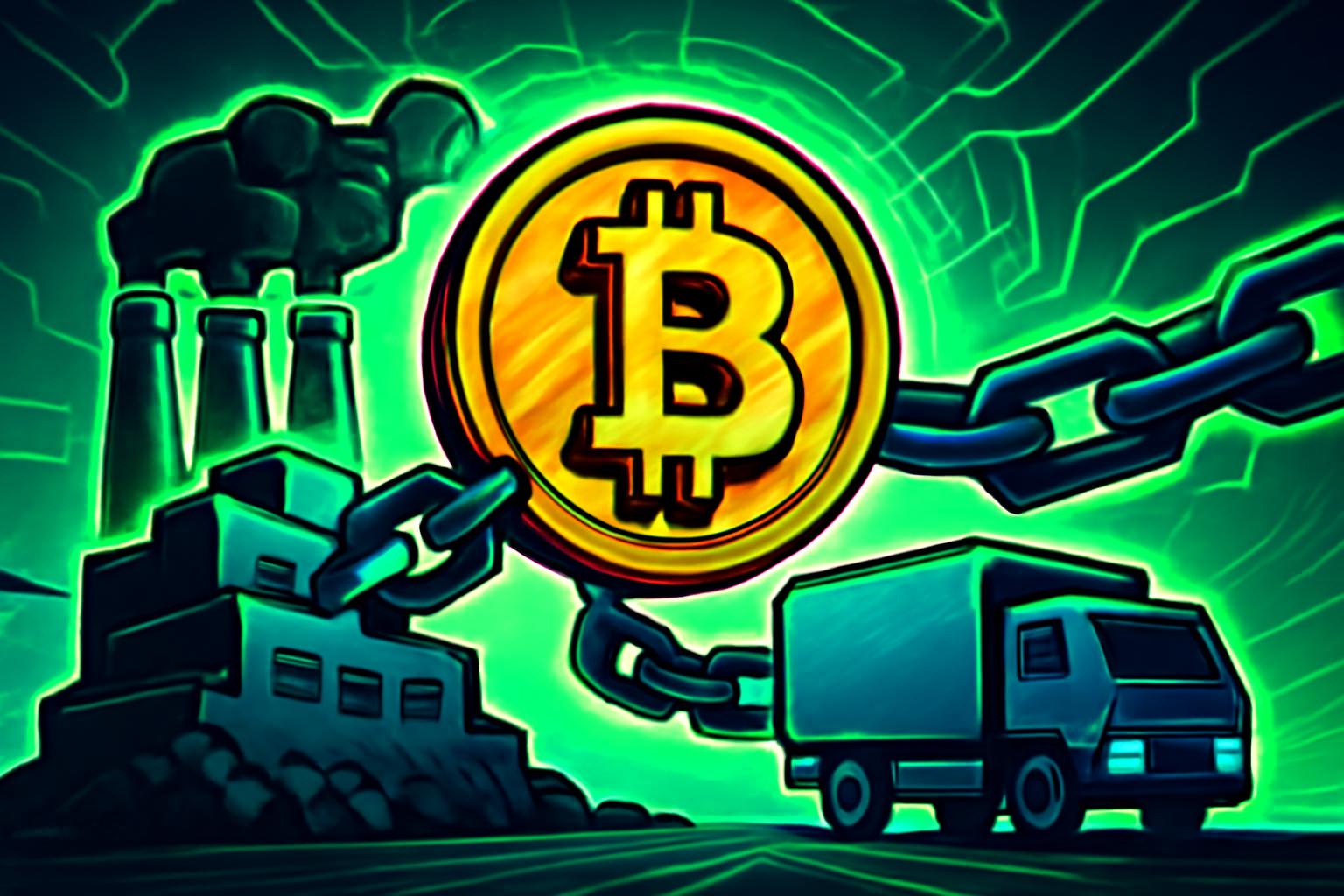

Blockchain technology is quietly rebranding itself from crypto trading to building trust and verifying information about emissions. Companies are under growing pressure to measure Scope 3 emissions—the indirect carbon output tied to suppliers, logistics and product use. These emissions often account for 70% to 90% of a company’s total climate footprint, yet they remain the hardest to calculate. Disputes between suppliers over data accuracy are common, making verification a major challenge.
According to the World Economic Forum, eight global supply chains generate more than half of worldwide greenhouse gas emissions, intensifying scrutiny on procurement networks spanning hundreds or thousands of vendors. For large corporations, the lack of consistent, trusted data across these networks has become both a regulatory and reputational risk. Consulting firms like Deloitte describe blockchain as a shared digital ledger that allows multiple parties to log and review data without retroactive tampering. In theory, this creates a single source of truth for emissions reporting and compliance audits, and in practice the value depends entirely on data quality and participation from all partners involved.
Companies are betting on blockchain beyond crypto as pressure mounts to prove trust, trace emissions, and secure data, with roughly 70–90% of corporate emissions arising from Scope 3 sources and eight supply chains generating over 50% of global emissions. Blockchain offers tamper-resistant records that help track complex supplier data. In retail pilots, traceability tasks dropped from days to seconds, cutting risk and costs as global ESG reporting spend is projected to exceed $15 billion annually. Firms see blockchain as a practical tool for verification, not speculation.
Retailers were among the earliest adopters, with Walmart reporting that tracing the origin of U.S. mangoes dropped from nearly seven days to a few seconds using a blockchain-based system. Shipping followed a similar path. Maersk’s TradeLens platform aimed to streamline global logistics, but it was shut down after failing to attract enough industry participants, and adoption proved to be the weakest link.
Can blockchain fix carbon markets? Carbon credits are another area attracting blockchain interest, with instant verification through sensor-linked records potentially reducing fraud. The Australia Institute research shows that many offset programs still suffer from weak integrity, with digitizing transactions not guaranteeing that emissions reductions are real, permanent, or additional.
Developers are now pitching blockchain as a business opportunity rather than a back-end system. Some argue companies can productize internal verification processes, charging others for access. Tokenization, where digital assets represent fractional ownership of physical goods, is also being explored, with models aiming to justify investment through direct revenue. Wharton professor Kevin Werbach describes blockchain as a new structure of trust, but not a replacement for governance where rules, dispute resolution, and accountability remain essential.
Permissioned blockchains, limited to verified participants, now dominate enterprise pilots. Whether they become lasting infrastructure or fade like earlier experiments depends on long-term commitment and funding.
Creates tamper-resistant records so emissions data cannot be altered after entry. Links suppliers, logistics firms and buyers to a shared ledger for one source of truth. Helps track Scope 3 emissions, which account for up to 90% of corporate carbon output.
Uses sensors and tracking tools to capture data in near real time. Improves audit trails for ESG reporting and regulatory compliance. Reduces disputes between partners by increasing data transparency. Enables faster tracing of products and materials across complex supply networks.










Leave a Reply