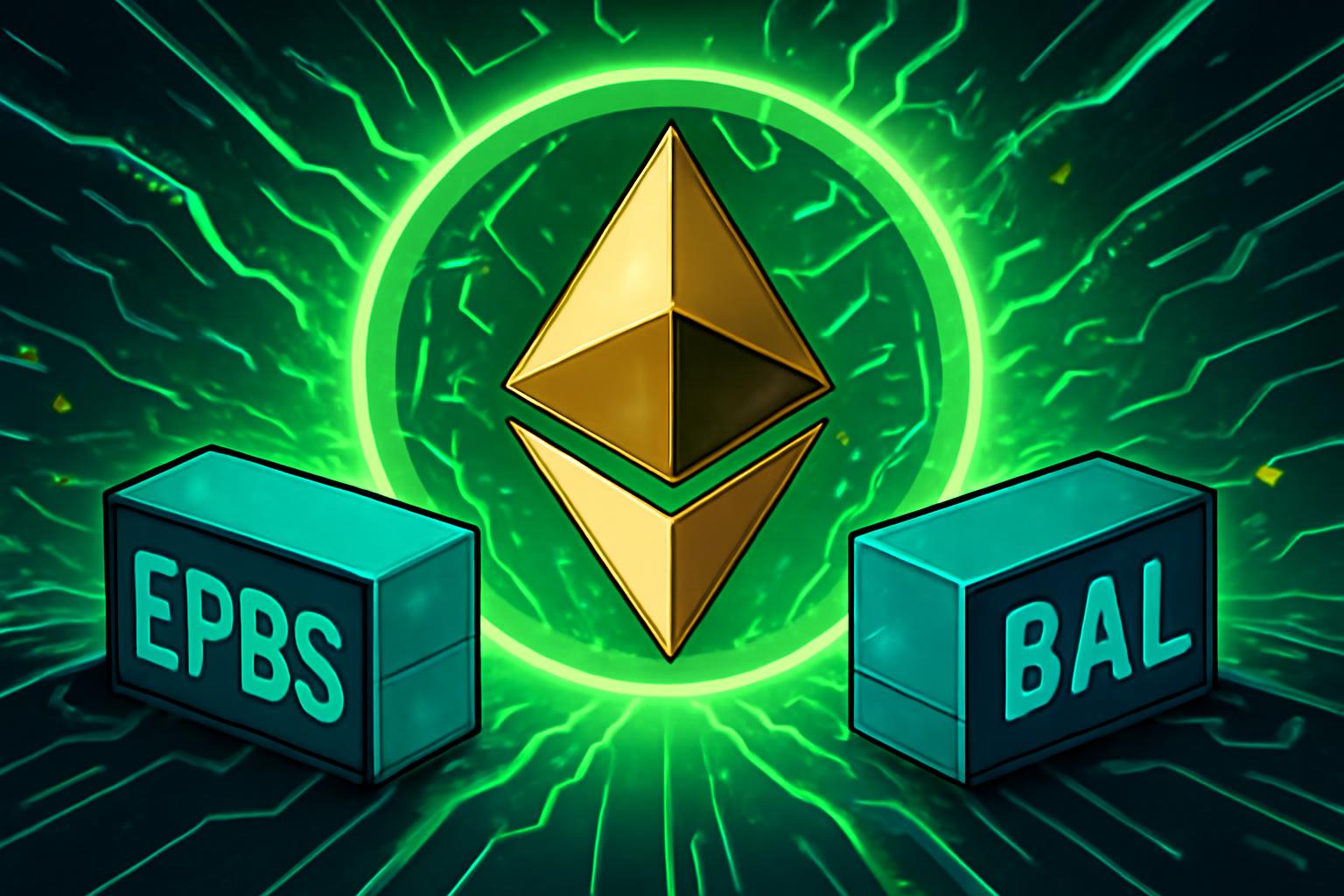

Glamsterdam is Ethereum’s next hard fork, scheduled for the first half of 2026 with a target around June, contingent on testnet validation. The upgrade centers on two headliner EIPs: EIP-7732 (Enshrined Proposer-Builder Separation) on the consensus layer and EIP-7928 (Block-Level Access Lists) on the execution layer, with early testing having progressed from Devnet-4 to Devnet-5. For traders, the primary implications lie in shifting block construction on-chain, reducing reliance on external relays, and potentially minimizing MEV extraction.
Under the Enshrined Proposer-Builder Separation, block-building logic moves into the protocol, separating proposer and builder roles to reduce centralized influence and censorship risk. MEV extraction could be reduced by up to 70%, translating into more predictable and fairer execution for trading, borrowing, and liquidity provision on Ethereum’s base layer. Glamsterdam also enables parallel transaction processing through BALs (Block-Level Access Lists) that pre-declare the accounts and smart contracts a block will touch.
This enables near-simultaneous processing of transactions that interact with different parts of the state, targeting roughly 10,000 transactions per second and increasing raw capacity as the gas limit per block rises from 60 million to 200 million. This phase represents the initial step toward greater parallelism, with future upgrades planned to extend parallel processing as deployments mature and real-world data accumulate, though timelines remain uncertain. Gas costs are set to drop by about 78.6% through EIP-7904, aligning gas fees with actual resource usage and, when combined with the higher block capacity, could dramatically reduce on-chain transaction costs for both simple transfers and complex multistep interactions. The upgrade also decouples state creation from execution gas, enabling more efficient scaling of the network’s state without proportional growth in storage requirements.







Leave a Reply