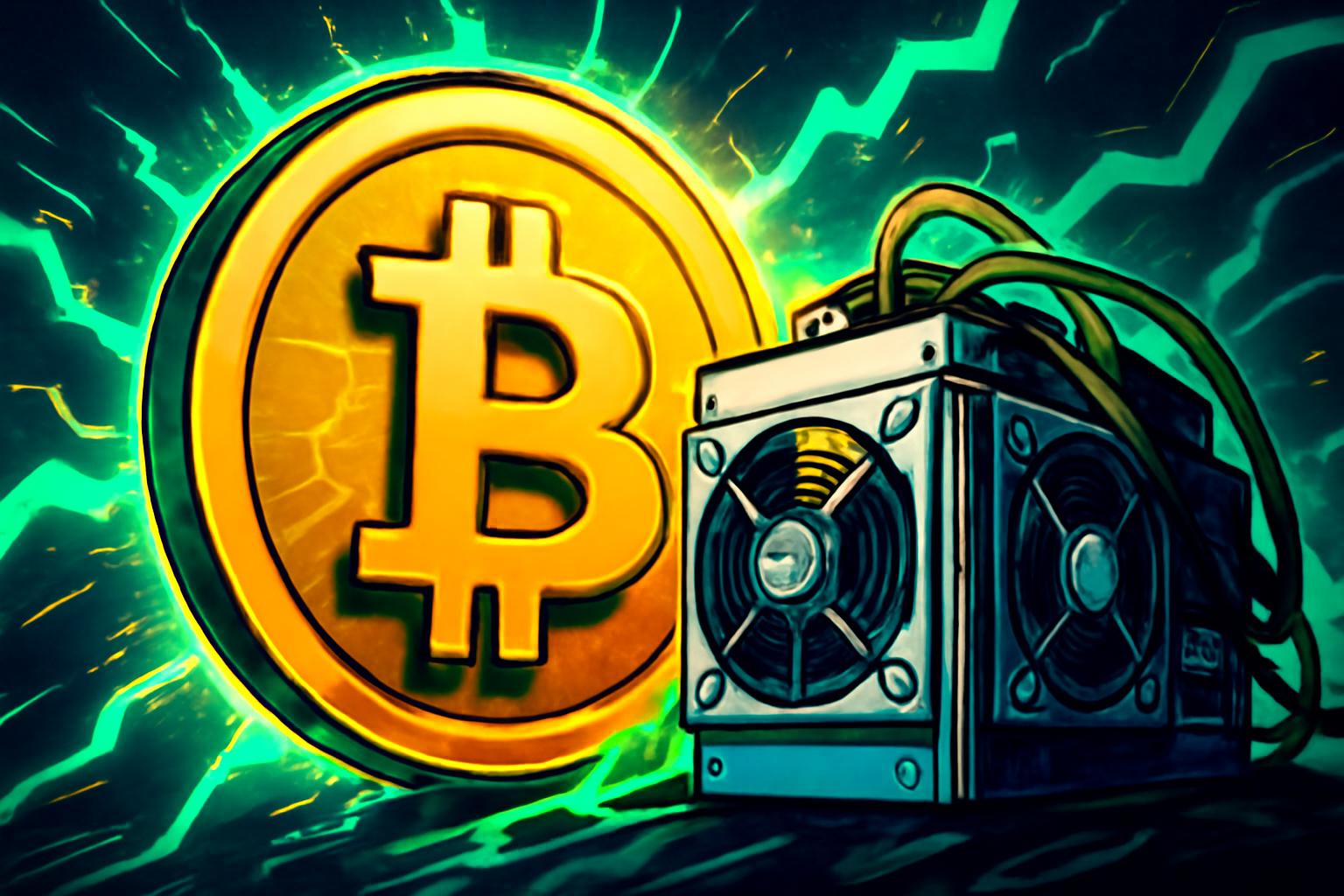

Cryptocurrency mining remains the backbone of blockchain security, validating transactions and introducing new coins, primarily through Proof of Work where miners compete to solve complex mathematical puzzles. When you mine, your hardware performs trillions of calculations per second, searching for a valid hash that meets network difficulty requirements. The first miner to find the solution broadcasts the new block to the network, earning the block reward and associated transaction fees. Bitcoin’s network hashrate has grown enormously, surpassing 600 exahashes per second in 2026, reflecting the scale of computational power securing the blockchain.
This scale means solo mining Bitcoin has become nearly impossible for individuals without industrial resources. Mining rewards consist of two components: the block subsidy and transaction fees. Bitcoin’s block subsidy is currently 3.125 BTC per block after the 2024 halving, with transaction fees contributing 10 to 30 percent of total revenue depending on network congestion. These fees fluctuate based on user demand for block space, sometimes spiking during high activity periods.
Mining hardware falls into two main categories. ASIC miners dominate Bitcoin mining with purpose-built chips optimized for SHA-256 hashing, while GPU rigs remain viable for altcoins like Ethereum Classic or Ravencoin that use memory-intensive algorithms resistant to ASIC optimization. Mining difficulty adjusts periodically to maintain consistent block times, typically every 2,016 blocks for Bitcoin, ensuring new blocks appear roughly every 10 minutes regardless of total network hashrate.
The mining process follows these essential steps: Collect pending transactions from the mempool into a candidate block. Add a coinbase transaction crediting the block reward to your address.
Compute hash values by varying the nonce until finding a valid solution. Broadcast the completed block to network nodes for verification. Receive confirmation and claim your mining reward.
This competitive process requires substantial computational resources and electricity, making efficiency and cost management crucial for profitability. Choosing the right mining hardware determines your operational efficiency and profit potential. ASICs dominate Bitcoin mining, with models like Antminer S19 XP delivering high hashrates while consuming significant power. GPU mining remains relevant for memory-hard algorithms, with modern graphics cards consuming hundreds of watts and delivering competitive performance on select networks.
Efficiency metrics matter enormously for long-term profitability; physical setup requires careful planning to ensure safe, stable operation. ASIC miners demand dedicated circuits, and proper electrical infrastructure is essential to mitigate fire risks. Ventilation must exhaust heat to prevent thermal throttling and failure. Pro Tip: connect ASIC miners directly to wall outlets with appropriate voltage and amperage ratings.
A robust setup includes dedicated circuits, adequate ventilation, stable internet, temperature monitoring, and dust filtration. Start with one or two units to learn operational requirements before scaling up. Understanding mining hardware and cost dynamics helps optimize profitability over time. Electricity costs represent the lion’s share of running Bitcoin mines, typically 70 to 90 percent of expenses, so rates above $0.10 per kWh can erode profitability at current difficulty levels.
Hardware investment forms the second major expense, with current generation ASIC miners ranging from $2,000 to $8,000 depending on specifications and market conditions. Factor in maintenance costs, replacement parts, and potential downtime when building your financial model. Steps to profitability include assessing total hashrate and rewards, inputting electricity costs, estimating pool fees, accounting for depreciation, considering taxes, and modeling price scenarios. Bitcoin halving cycles reduce block rewards by about four years; the most recent halving in 2024 reduced the subsidy, with the next anticipated in 2028 affecting long-term planning.
Mining rewards are taxed as ordinary income upon receipt, with capital gains applying on sales; miners should keep detailed tax records. Self-employed miners may deduct ordinary business expenses, including electricity and depreciation, but must pay self-employment tax on net mining income, so professional tax guidance is advised. Cloud mining can be considered for electricity-cost-driven profitability, though these arrangements entail risks and fee structures. Starting mining requires careful planning, with a focus on safety, proper cabling, ventilation, and compliance to avoid costly mistakes.
Common mistakes include overloading electrical infrastructure, neglecting cooling, failing to keep detailed income and expense records, ignoring pool fee structures, and underestimating noise and maintenance needs. Electrical safety is paramount; hire licensed electricians for installations beyond basic setups, and ensure dedicated circuits and proper ventilation.








Leave a Reply