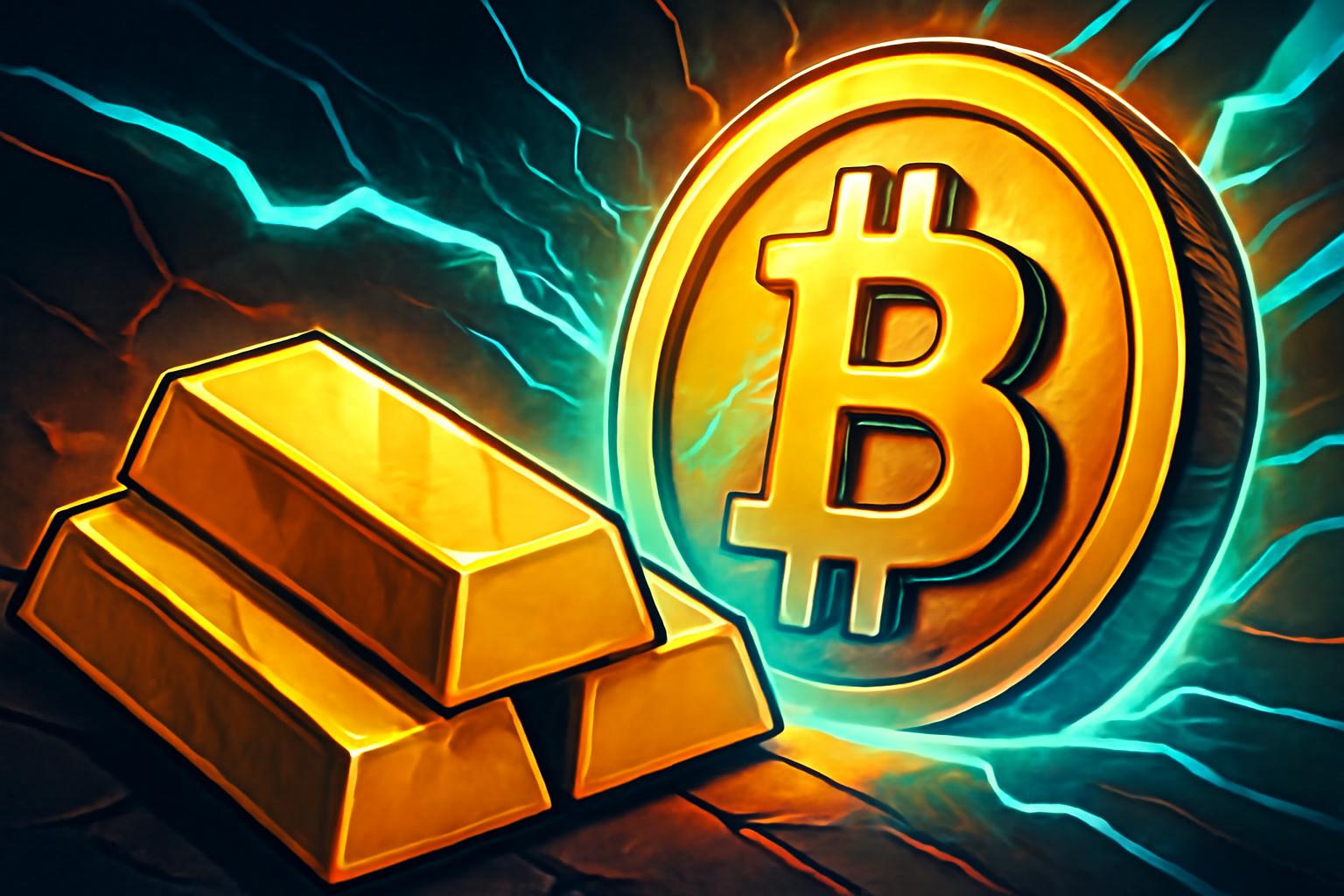

These assets will help you to layer either safety or some risk into your portfolio. There’s a reason gold has been the fallback asset for anxious investors for thousands of years now. It’s scarce, and everyone accepts that it has value. And thanks to plenty of upheaval in our world today, it’s reasonable to expect gold to continue to gain in value.
The price of the SPDR Gold Shares, (GLD), a gold exchange-traded fund (ETF) that grants exposure to the spot price of gold, is up by 79% during the past 12 months alone (as of March 11). During that period as well as before, central bank purchases have been a relentless tailwind, with global gold holdings now accounting for nearly 20% of official reserves. Persistent questions about the dollar’s reserve currency status, not to mention global trade policy and geopolitical instability, have only reinforced demand for gold. None of these price drivers will ever require a stunning product launch or an earnings report to go better than expected.
Bitcoin, despite being called digital gold from time to time, is a far riskier investment than gold. The thesis for buying Bitcoin is somewhat similar to gold’s. It’s a scarce asset which is increasingly accepted as a store of value. Many organizations, individuals, and governments are purchasing it to ensure that they have a sufficient allocation for the future, when it will only be harder to mine, and likely more expensive to buy. If you don’t already own some, you should probably consider buying at least a little, assuming that your portfolio is already diversified with safer picks from the traditional financial world.
When the next halving cuts newly produced supply in half, sometime in about March or April 2028, only 225 new Bitcoins will be added to the circulating supply on a daily basis compared to 450 today. No person, company, or government can change that schedule, and the inevitability of the halving is itself part of what gives Bitcoin value, as it’s a property that investors can depend on to shape its supply indefinitely. If you don’t already own some, you should probably consider buying at least a little, assuming that your portfolio is already diversified with safer picks from the traditional financial world.
XRP isn’t as scarce as Bitcoin, and although it might store some value, it’s really intended to be used as a financial tool of sorts by financial institutions. Ripple, XRP’s issuer, wants to build an entire financial services stack around XRP and its chain, the XRP Ledger (XRPL). This means a bank or currency exchange house could do everything from saving fees on money transfers to tapping liquidity and managing tokenized real-world assets (RWAs) on one platform. Ripple is framing the coin as the lifeblood that ties its various financial products and services together by acting as a medium for settling transactions and paying transaction costs on its network, among other purposes. If big banks end up using the XRPL in the ways that Ripple envisions, they will likely end up boosting the price of the coin by way of needing to buy a lot of it. Nonetheless, investors need to be aware that as of today, generating demand for XRP isn’t immediately value-accretive to holders. Each transaction fee is very small, as are the ledger’s other expenses for users. So it will take a truly colossal amount of sustained and intense financial activity on the XRPL to meaningfully boost XRP’s price. So don’t buy this coin until you own safer investments like gold as well as Bitcoin, and consider that it might be more appropriate to allocate a smaller sum than $3,000 if you decide to buy it. You don’t have to choose only one of these three today and hold it forever. Each of these assets holds and gains value differently, and demands a different approach from the people who own it.
Gold has long stood as a safe-haven asset for anxious investors, valued for its scarcity and broad acceptance. Recent turmoil has kept demand robust, with central bank purchases supporting the price; the GLD ETF, which tracks gold’s spot price, has surged about 79% over the past year (as of March 11). Global official reserves in gold now approach 20%, as questions about the dollar’s reserve currency status add to the appeal of holding gold.
Bitcoin, while often dubbed digital gold, carries higher risk than gold but shares a similar attraction as a scarce store of value. The case for buying Bitcoin rests on its finite supply and growing adoption by institutions and individuals seeking portfolio diversification. The next halving—expected around March or April 2028—will reduce newly produced supply to roughly 225 Bitcoins per day from 450 today, a fixed schedule that underpins Bitcoin’s supply dynamics and perceived value. If you don’t already own some, consider adding a modest position, assuming your portfolio already includes safer traditional assets.
XRP presents a different dynamic, serving primarily as a financial tool within the XRP Ledger (XRPL). Ripple envisions XRPL as a platform for saving on transfers, gaining liquidity, and managing tokenized real-world assets on a single network. While large banks adopting XRPL could boost XRP’s price due to increased demand, today the coin’s transaction fees and operating costs are low, and sustained, substantial activity would be required to meaningfully lift its value. Investors should prioritize safer investments like gold and Bitcoin first, and consider a smaller allocation to XRP if they choose to diversify, recognizing that no single asset guarantees immediate value gains.









Leave a Reply