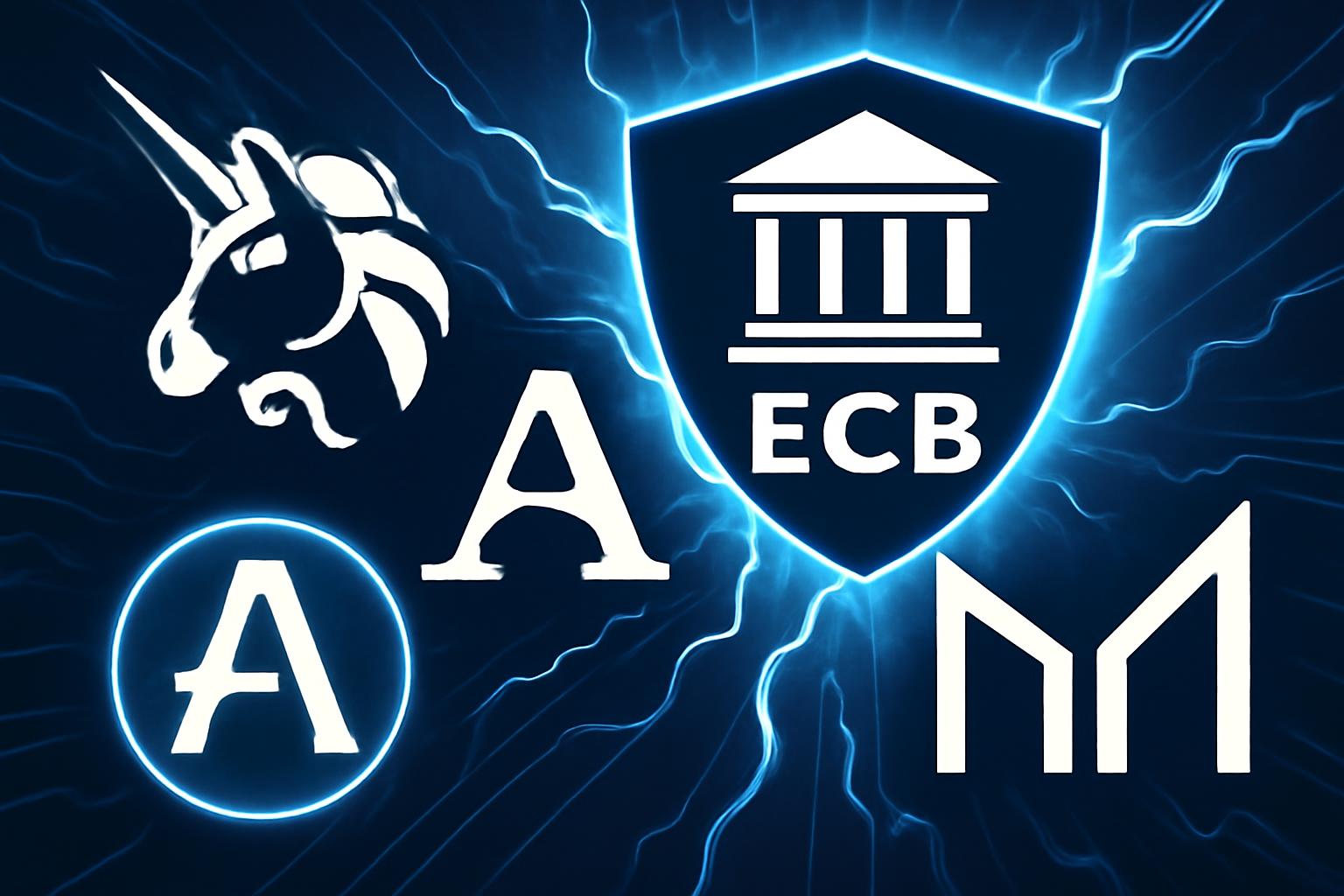

The European Central Bank published a working paper on March 26 identifying concentrated governance in four major DeFi protocols: Aave, MakerDAO, Ampleforth, and Uniswap. The study notes that while governance tokens are held across tens of thousands of addresses, the top 100 holders control more than 80% of the supply in each protocol. Based on holdings snapshots from November 2022 and May 2023, a large share of governance tokens could be linked to either the protocols themselves or to exchanges, with Binance identified as the largest centralized exchange holder across the four protocols.
The report argues that these findings challenge the notion that DAOs are inherently decentralized, raising questions about accountability and complicating efforts to identify regulatory anchors under MiCA, which currently excludes fully decentralized services from its scope. It also analyzes who votes on key proposals, noting that top voters are typically delegates wielding voting power delegated by smaller holders. In Ampleforth, the top 20 voters control 96% of delegated power; in MakerDAO, the top 10 hold 66% of delegated votes; and in Uniswap, the top 18 hold 52%. Kavi Jain, senior research associate at Bitwise, noted that many large DeFi protocols were not as decentralized in practice as they might appear, especially in the earlier stages, where a small group still has meaningful influence over decisions, pointing to the recent Aave governance debate illustrating concentration of voting power even within a DAO structure.
Approximately one-third of top voters cannot be publicly identified; among those who can be identified, the largest groups are individuals and Web3 companies, followed by university blockchain societies and venture firms. Experts caution that attributing protocol-linked holdings to founders, developers, or treasuries remains difficult, and it is unclear whether exchange wallets vote their own positions or those of customers. The study also cautions that data limitations mean the methodology cannot capture the full DeFi ecosystem, and identifying governance anchors may require information not publicly available. The findings echo warnings from the Financial Stability Board and others that DeFi’s promise of disintermediation can mask concentration and governance risk.












Leave a Reply