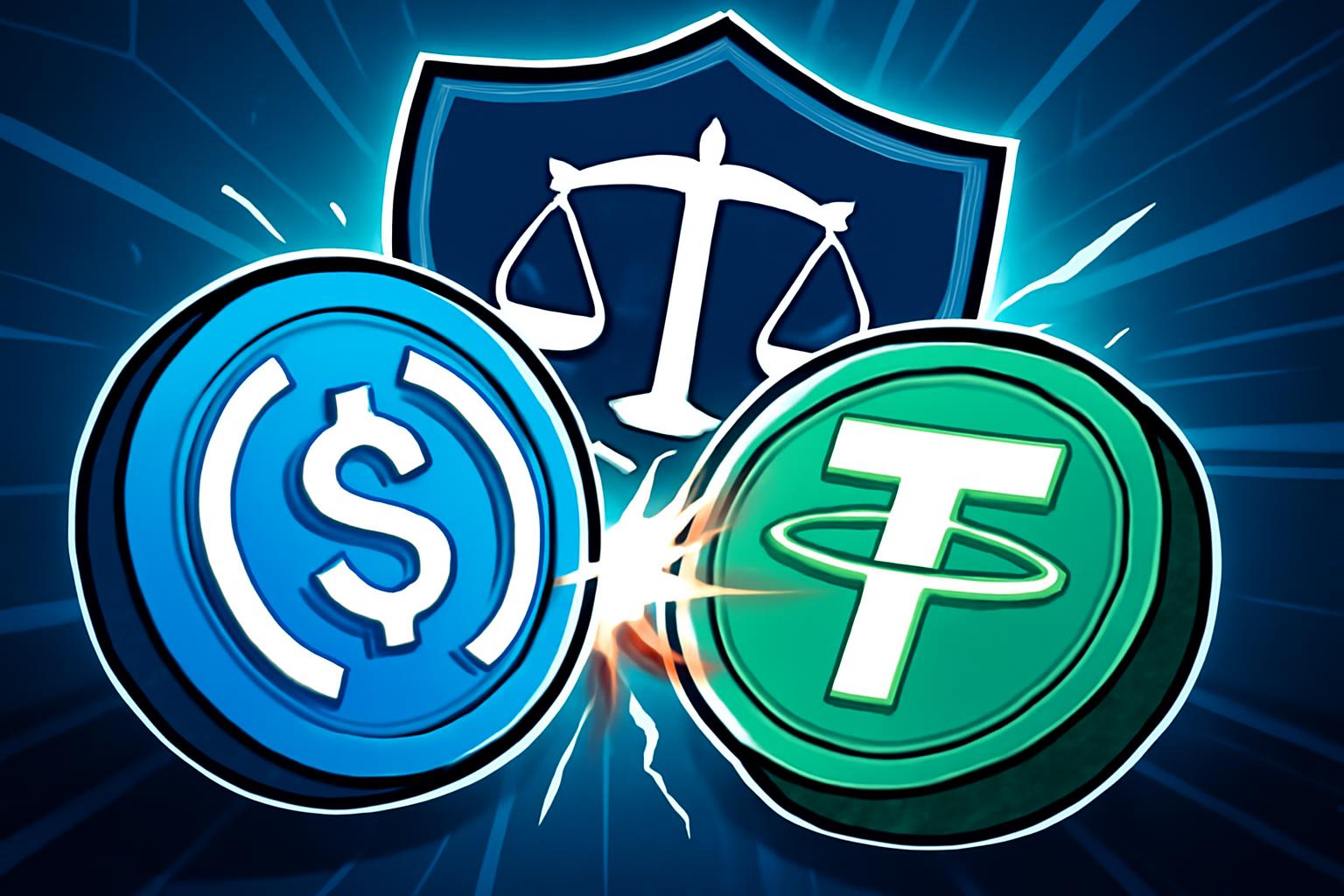

KPMG to audit Tether as investors share ‘intimate evening’ with Tether execs. The name of Tether’s ‘Big Four’ auditor has been revealed, Circle set a new record for stablecoin transactions, and euro-backed tokens are cool with being used for purposes beyond speculative trading. Tether has enlisted the help of a second Big Four firm (PwC) to help ready its internal systems for the audit. Circle’s upside optionality in setting new stablecoin transaction record.
USDC-issuer Circle’s share price still hasn’t recovered from the nosedive it suffered following news of Tether’s audit plans, coupled with hints that U.S. digital asset market structure legislation might limit crypto platforms’ ability to offer customers ‘rewards’ for holding stablecoins like USDC. In mid-March, Circle was trading over $130 but slipped to ~$100 after last week’s news. The shares took a further hit this week, dipping below $90 on Monday before staging a minor rally on Tuesday to close at $95.41 (+6.1%). For the year-to-date, Circle is still up 20.3%. Analysts suggested Circle’s selloff was overblown, noting that the real impact of a limit on stablecoin rewards would be tougher on Circle’s former USDC partner, Coinbase, which derives one-fifth of its revenue from these rewards.
USDC may have a smaller market cap ($77.2 billion) than USDT, but USDC is the undisputed leader when it comes to stablecoin usage on decentralized finance (DeFi) platforms. In February, USDC transfer volume on the Ethereum network (where most DeFi operates) rose 250% year-on-year to $1.7 trillion, while other stats showed USDC accounting for ~70% of all stablecoin transaction volume that month. Then there’s agentic AI payments. Circle claims USDC holds a near-monopoly (98.6%) on these payments, and analysts appear to agree.
Bernstein’s Gautam Chhugani wrote last week that agentic machine payments—transactions entirely initiated, authorized, and settled by non-humans—are “an upside optionality for stablecoins.” Bernstein believes Coinbase’s role in building the x402 agentic payments protocol, coupled with the company’s ties to Circle, bode well for USDC, which also benefits from its reputation as a more regulatory-friendly, less controversial stablecoin than USDT. Bernstein called Coinbase and Circle the “best proxies for stablecoin upside.” On Monday, Circle’s global marketing chief Peter Schroeder claimed that USDC had processed “over a billion unique transactions” in March, marking a new all-time monthly high for any stablecoin.
Impressive, but could there be a downside to this rapid growth in stablecoin activity? Stablecoin velocity: velocirapturous? A new report by Geoff Kendrick, digital assets analyst at UK bankers Standard Chartered, credits USDC’s agentic AI use cases with contributing to a surge in stablecoin “velocity,” aka the rate at which stablecoins change hands. Stablecoins are now being turned over an average of six times per month, twice the rate from two years ago.
Kendrick said USDC’s velocity shot up last October on both the Solana and Base networks, in part due to agentic AI payments. This growth has slowed somewhat since that surge, suggesting something of a novelty factor as individuals rushed to test the possibilities of what autonomous agents could do if handed control of a digital wallet. The bank now believes the new agentic use cases are “additive” and is therefore maintaining its forecast that the overall stablecoin market will be worth $2 trillion by 2028, a sixfold-plus increase from its current ~$315 billion cap. The bank suggests this growth could lead to $1 trillion in additional sales of U.S. Treasury bills, which make up the largest chunk of stablecoin issuers’ reserve assets.
Echoing other analysts, Kendrick said there appeared to be a clear distinction in the roles played by both USDC and USDT, with the latter used largely as a means of value preservation in emerging markets, while USDC acts as the primary digital dollar for financial transactions in developed markets. Visa and Dune Analytics offers some comfort to these dollar-drama queens, noting that stablecoins denominated in local currencies are being used more for payments than facilitating token trades or being parked in protocols as a source of yield. The market cap of all non-U.S. stablecoins was $1.2 billion in February, up from just $700 million in January 2023. The euro-token share is all the more impressive since it doesn’t include EURT, Tether’s euro-backed token, which the company scrapped last year due to Tether’s unwillingness to conform to the European Union’s Markets in Crypto-Assets Regulation MiCA.
The number of unique wallets holding non-U.S. stablecoins rose from just 40,000 in January 2023 to over 1.2 million this February. Around one-quarter of non-U.S. stablecoins reside on digital asset exchanges, while another 7.5% are earning yield via DeFi lending protocols. Nearly half (46%) remain in individual wallets, suggesting people are actually using these tokens for purposes other than speculative trading. From January 2023 to February 2026, the number of non-U.S. unique sending addresses rose from 6,000 to 135,000.
Over the same span, non-U.S. transfer volume grew from $600 million to $10 billion. Euro-backed tokens accounted for 85% of this volume, and EURC accounted for an astonishing 90% of the euro-backed transfer volume. The report credits MiCA with spurring the euro-backed transfer volume growth, adding that Brazilian real-, Japanese yen- and Singapore dollar-backed tokens all saw significant user growth following the introduction of formal regulatory schemes in those markets. By contrast, Kaiko Research claimed euro-backed stablecoins have collectively failed to generate meaningful trading activity.
Kaiko said monthly euro-backed stablecoin spot trading volume is a pittance compared to dollar-backed tokens, averaging only around $100 million per month this year, roughly half of what they were doing in early 2024. However, that earlier date precedes Tether killing off EURT, which like USDT was a mainstay of token trading on centralized exchanges. Kaiko’s figures actually support the Visa/Dune interpretation that euro-backed stables are being used for reasons other than speculative token trades.













Leave a Reply