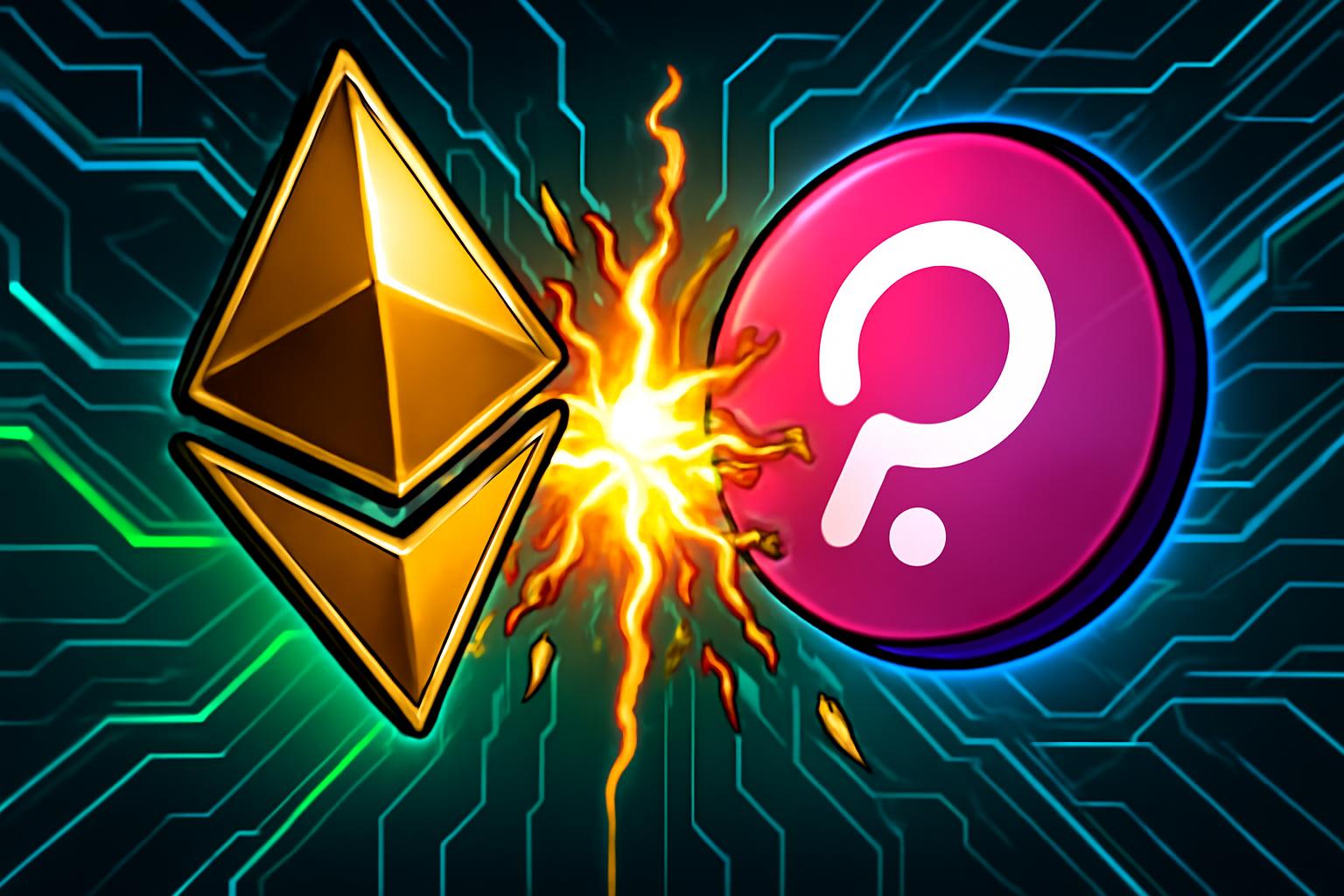

Ethereum (ETH) and Polkadot (DOT) generally attract different types of cryptocurrency investors. Ether, the native token of Ethereum, is the world’s second-most-valuable cryptocurrency after Bitcoin, and a $10,000 investment in its earliest trade in 2015 would be worth about $10.5 million today. Polkadot is a smaller altcoin created by Ethereum’s co-founder Gavin Wood, and a $10,000 investment in its first trade in 2020 would have fallen to roughly $6,900. Ethereum transitioned from proof-of-work to proof-of-stake in 2022, after The Merge, allowing Ether to be staked and enabling smart contracts, dApps, NFTs, and other tokenized assets.
Polkadot’s blockchain is built on proof-of-stake, with the Relay Chain handling security and cross-chain communication, while apps run on parachains with their own logic and tokenomics. This structure makes Polkadot’s parachains more flexible and often faster than Ethereum’s Layer-1, though Ethereum allows Layer-2 solutions to augment throughput on its L1. By bundling its L1 transactions and processing them on L2, Ethereum can achieve speeds comparable to Polkadot and other nimble PoS blockchains. Neither Ether nor Polkadot is scarce like Bitcoin, and Ether has a circulating supply of about 121 million with no fixed cap, while Polkadot capped its supply at 2.1 billion tokens last September.
Ether has burned a portion of its gas fees to throttle its rising supply since 2021. Ethereum’s Dencun upgrade could cut Layer-2 costs by more than 90%, potentially expanding its developer and user base. Polkadot recently upgraded its platform with on-demand blockspace, replacing expensive, long-term parachain slot auctions, and aiming to reduce costs and risks for app-specific chains. Its app-specific parachains, predictable fees, on-chain governance, and compliance-friendly architecture could also make Polkadot better suited than Ethereum for certain regulated finance, supply chain, and government clients.
Polkadot could still struggle to stand out in the crowded market of smaller PoS blockchains, and its price might eventually stabilize without millionaire-making gains over the next decade. In contrast, Ethereum still has significant upside if it becomes the default ecosystem for developing dApps, with potential millionaire-making gains over the next few decades.




Leave a Reply